Guy Novak
Hold TightGuy Novak is Yasmin’s father, her primary caretaker, and the adult most directly confronted with the consequences of her school humiliation. His efforts to shield her from further harm run alongside a more compromised response to the murder of his ex-wife, Marianne: he retaliates over a threatened affair video by sending it to Joe Lewiston’s wife. In the later crisis at Guy’s home, a gun he keeps there becomes essential to the family’s survival, giving his story a final reversal in which a concealed danger becomes a means of protection.
Identity and Family Background
Guy is a divorced father who has raised Yasmin as her primary caregiver. Marianne left when Yasmin was little, moved to Florida, and returned to see her daughter only four or five times a year. Guy describes the separation as an early difficulty Yasmin had managed to adjust to; before the events that trouble him, he remembers her as happy, outgoing, and popular. His account makes clear that he has been the steady parent in her daily life, while her mother’s absence remains part of their family history.
Guy’s sense of himself is closely bound to that responsibility. In a moment of private self-reproach, he thinks of fathering Yasmin and raising her as his most important accomplishment, then measures himself against what he considers his first duty: protecting her. When he cannot prevent her humiliation, his distress is not abstract. He experiences it as a failure in the role around which his life has been organized.
Fatherhood and Yasmin’s Humiliation
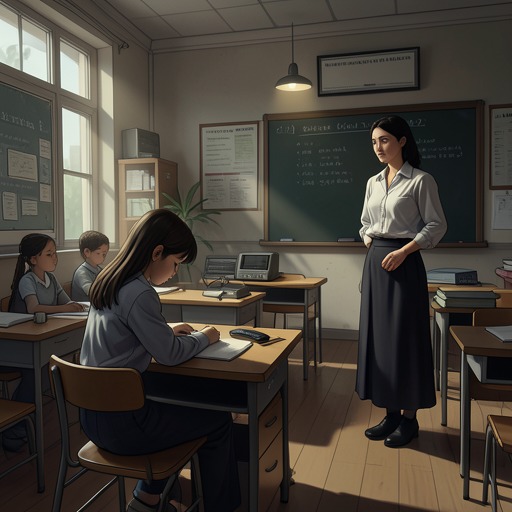
Guy sees the change in Yasmin after Joe Lewiston, her teacher, publicly draws attention to her slight facial hair while discussing chromosomes. She had been talking in class, and Lewiston’s remark turns that ordinary classroom disruption into a conspicuous personal humiliation. The other students laugh and begin using cruel nicknames. Lewiston apologizes the next day and asks the students to stop, while Guy confronts the principal, but neither gesture can undo what has already circulated among the children.
When Jill Baye comes to stay with Yasmin, Guy asks Mike Baye to speak privately on the front stoop. He tells Mike that Jill has been good for Yasmin and describes his uncertainty about what a parent can do after trying to provide for a child and seeing her hurt anyway. His careful account of the incident shows that he is not simply angry at a school’s failure to protect her: he is trying to understand why his formerly outgoing daughter has changed and whether he can still help her.
Guy explains that he once knew a boy who became a target of ridicule after an embarrassing incident in class, and that the mockery followed the boy through school. He sees a parallel between that remembered example and Yasmin’s experience: a public joke can outlast the moment that produced it. He does not offer this memory as a solution. Instead, it sharpens his fear that Yasmin’s humiliation may become a lasting part of her life. Unable to see the situation improving, he decides to put his house on the market, although he does not want to move. He thanks Mike for letting Jill sleep over, recognizing that the girls’ friendship offers Yasmin companionship when he cannot make the school environment safe.
The Home, the Girls, and His Sense of Control
The sleepover also shows Guy trying to preserve ordinary family life. He proposes taking the girls to a movie and for ice cream at Cold Stone Creamery, and mentions that his girlfriend Beth will join them. The next morning, after the girls have stayed up late, he comes to their room when a phone call wakes them. Such domestic details sit beside his much larger anxieties: he remains involved in Yasmin’s routines even as he feels unable to control what happens to her beyond the home.
His anxiety becomes especially stark when he returns to his driveway and sits gripping the steering wheel, overcome by helplessness. Looking at his reflection, he notices his thinning hair and the slow shift of his part, a change he fears other people might notice and mock. The self-consciousness echoes the social cruelty he is trying to keep away from Yasmin, though the text presents his concern about his appearance alongside, not as a substitute for, his deeper fear about her safety. He looks at the house he may sell and considers the paint and shrubs it would need. Even practical preparations for moving cannot disguise the reason he is contemplating it: he believes he has not protected his daughter.
Marianne’s Murder and the Lewiston Video
When Loren Muse approaches Guy, she first asks to speak with him privately, then asks about Marianne and her connections in the area. Guy explains that Marianne had been largely absent from Yasmin’s life and says that Reba Cordova was the local friend with whom Marianne had been especially close. He initially questions why Muse wants to know about his ex-wife. When Muse tells him that police believe Marianne was murdered, he struggles to process the news.
Later, Guy calls Tia Baye and confirms that he told the police he sent the video of Marianne and Joe Lewiston to Joe’s wife. Tia asks him about the act as an attempt at revenge; Guy does not elaborate, telling her to let it go before ending the call. The later investigation clarifies the distinction between Marianne’s threat and Guy’s choice: Marianne had threatened Joe with the video but had decided that the threat itself was enough punishment. Guy, unwilling to leave it there, sent it to Joe’s wife. His action therefore belongs to a separate line of consequence from Marianne’s murder, while also exposing how the old affair continued to affect the people around them.
Guy’s grief becomes unmistakable when he tells Tia that he has identified Marianne’s body. Even then, he checks that Yasmin and Jill are safe, explaining that Beth is watching them. That concern does not erase his anger or the retaliatory choice he made over the video; instead, it shows how his attention repeatedly returns to the immediate safety of the children in his care.
The Threat at His Home and the Gun
During a later confrontation at Guy’s house, Nash approaches him while the girls are upstairs. Guy does not retreat from the question that has been consuming him: he asks Nash whether he killed Marianne. Nash answers by pointing out that she was Guy’s ex-wife. The exchange brings Guy’s bereavement directly into the danger facing his household; the family crisis is not separate from his loss but passes through it.
The ending gives a consequential role to a detail the girls already know: Guy keeps a loaded gun in the house. Jill and Yasmin had learned about it while snooping, and that knowledge becomes crucial during the threat. Tia later reflects that their snooping had helped the family recognize that Adam Baye was in trouble, and that awareness of Guy’s gun was also necessary to keep them from being killed. The gun’s presence carries an obvious risk, but the episode reverses the expected outcome: rather than causing the disaster, it helps the family survive it.
Guy’s arc is shaped by protection repeatedly tested against limits. He cannot stop the ridicule that changes Yasmin’s life, cannot restore Marianne, and responds to the affair-video threat with a private act of revenge that affects Joe’s household. Yet the novel does not reduce him to either a helpless father or a retaliatory ex-husband. He is both the parent who keeps checking that the girls are safe and the man whose choices complicate the aftermath of Marianne’s death. The final importance of his gun, known to the girls because they have been watching and investigating, makes that contradiction concrete: in a story wary of surveillance and intrusion, what the children discover can be both troubling and lifesaving.